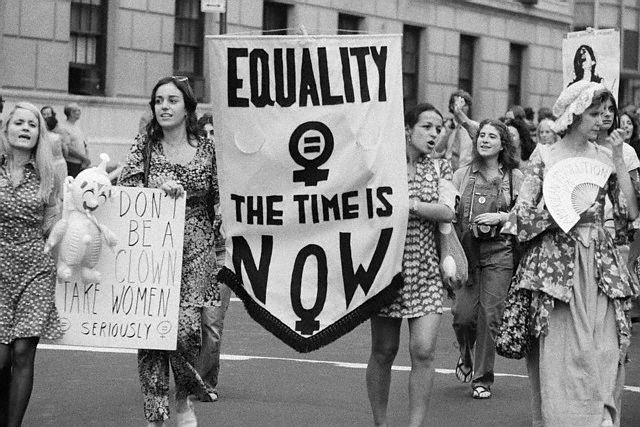
The emergence of the National Organization for Women (NOW) in 1966 marked a turning point in the modern women’s rights movement. NOW was not just another advocacy group. They represented a deliberate attempt to institutionalize feminist demands within the American political system. It translated widespread frustration into coordinated action, channeling the energy of second-wave feminism into a sustained campaign for systemic reform. In doing so, NOW helped shift the women’s rights movement from diffuse activism into a national force capable of legal, cultural, and political transformation.
Before the founding of NOW, the struggle for gender equality was largely decentralized. Though women had gained the right to vote in 1920, they remained marginalized in the political process and excluded from many economic and educational opportunities. The social conservatism of the postwar era reinforced traditional gender roles, particularly for white, middle-class women. Yet by the early 1960s, that stability was unraveling. Women entered the workforce in increasing numbers, gained access to higher education, and grew dissatisfied with the limitations of domestic life.¹ Betty Friedan’s The Feminine Mystique (1963) articulated this discontent, sparking a collective awareness that laid the groundwork for organized resistance.²
NOW emerged from this moment of awakening with a clear purpose which was to achieve full equality for women through legal and institutional means. Its founding statement declared a commitment to “bring women into full participation in the mainstream of American society.”³ In contrast to more radical feminist groups that sought revolutionary change outside the system, NOW focused on reforming the system from within. This pragmatic approach broadened the appeal of the movement, allowing it to influence legislation, litigation, and public discourse.
NOW in the Political and Cultural Arena
NOW’s early victories were anchored in its legal and policy agenda. One of its initial priorities was ensuring the enforcement of Title VII of the Civil Rights Act of 1964, which prohibited sex discrimination in employment. Though the law had been passed, the Equal Employment Opportunity Commission (EEOC) was reluctant to act on gender-based claims due to a combination of factors, including legal interpretation, political pressures, and changes in the agency’s leadership. NOW directly challenged this idleness, pressuring the EEOC to recognize sexual discrimination as a legitimate legal issue.⁴ This advocacy helped transform Title VII from a symbolic gesture into a usable tool for working women across the country.
NOW also played a central role in the passage and implementation of Title IX in 1972, which mandated gender equality in education. The organization lobbied Congress, submitted amicus briefs, and mobilized its membership to advocate for the law’s enforcement.⁵ Title IX became a cornerstone of educational equity, especially in expanding opportunities for women in higher education and athletics. While the effects were not immediate, they were profound, reshaping the academic landscape for generations of women.
In the broader cultural arena, NOW’s influence was equally significant. Through public campaigns, legal action, and grassroots organizing, NOW challenged widespread gender stereotypes and elevated feminist discourse. Its members staged protests, published newsletters, and appeared in the media, framing feminism not as a fringe ideology but as a legitimate civic movement.⁶ This visibility helped normalize feminist perspectives, even as it provoked backlash from conservative critics, both male and female. While groups like the Women’s Liberation Movement pushed the cultural boundaries of feminism, NOW provided a structured platform that brought feminist issues into the legislative and policy mainstream.
One of the organization’s most ambitious, yet ultimately unsuccessful, efforts was the campaign to ratify the Equal Rights Amendment (ERA). After Congress passed the ERA in 1972, NOW spearheaded a nationwide push for state-level ratification. The campaign initially gained momentum, but opposition, particularly from conservative activists like Phyllis Schlafly, stalled progress.⁷ Despite intense lobbying and public demonstrations, the amendment fell short of the necessary number of ratifying states by the 1982 deadline. While the ERA campaign failed legislatively, it galvanized a generation of feminists and further cemented NOW’s role as the institutional face of the movement.
The structure and strategy of NOW also shaped the character of feminist engagement. Unlike smaller, ideologically rigid groups that remain decentralized, NOW functioned as a membership-based organization with regional chapters and a formal leadership hierarchy. This structure allowed it to coordinate large-scale campaigns and engage in policy advocacy, but it also created tensions around inclusivity and representation. Critics, particularly women of color and working-class women, argued that NOW’s agenda reflected the concerns of white, middle-class professionals and not theirs.⁸ This critique exposed a fault line within the movement between those seeking broad-based structural reform and those demanding intersectional analysis and representation.
Nevertheless, the legacy of NOW’s approach to feminist advocacy remains profound. Its ability to translate grassroots activism into institutional pressure marked a new stage in the women’s rights movement. By operating within the frameworks of law, policy, and media, NOW helped transform feminist aspirations into concrete social and legal changes. It legitimized feminist demands in the eyes of mainstream institutions while maintaining pressure on those institutions to change.

Long-Term Consequences for Gender Equality
The long-term impact of NOW’s work is evident in numerous dimensions of American life. Workplace protections, anti-discrimination laws, reproductive rights, and educational access all bear the imprint of NOW’s sustained efforts. In legal precedent, public awareness, and institutional policy, the organization helped establish gender equality as a fundamental national principle. Yet it also revealed the challenges of reform, such as the limits of legal change, the persistence of cultural resistance, and the complexity of coalition-building in a diverse movement.
The organization’s model, pragmatic, persistent, and policy-driven, offered a blueprint for future advocacy. While newer feminist movements have adapted different methods and priorities, many continue to rely on the infrastructure that NOW helped build. From litigation strategies to public messaging campaigns, the tools of modern feminist activism owe much to the groundwork laid in the 1960s and 1970s.
The Enduring Significance of Institutional Feminism
In my final analysis, the National Organization for Women played a critical role in shifting the women’s rights movement from a series of disparate grievances to a cohesive and influential political force. Its efforts helped redefine citizenship, labor, and education in gender-inclusive terms. More than a lobbying group or a protest movement, NOW served as a bridge between radical critique and institutional reform. That tension between idealism and pragmatism continues to define feminist politics to this day, over 50 years later.
While critiques of its inclusivity remain valid, the legacy of NOW’s work is undeniable. It advanced the conversation around gender equity and demonstrated that sustained, organized pressure can yield structural change. Like many of its contemporary movements, such as civil and gay rights, NOW transformed how Americans understood justice, not as a private concern, but as a public imperative.
Bibliography
- Chafe, William H. The Paradox of Change: American Women in the 20th Century. Oxford University Press, 1991.
- Friedan, Betty. The Feminine Mystique. W.W. Norton, 1963.
- National Organization for Women. “Statement of Purpose,” 1966.
- Freeman, Jo. The Politics of Women’s Liberation. David McKay Company, 1975.
- U.S. Department of Education. Title IX and Sex Discrimination.
- Rosen, Ruth. The World Split Open: How the Modern Women’s Movement Changed America. Penguin, 2000.
- Mansbridge, Jane. Why We Lost the ERA. University of Chicago Press, 1986.
- Hooks, Bell. Ain’t I a Woman: Black Women and Feminism. South End Press, 1981.
 Deon Nguyen
Leave a comment