The emergence of the Mattachine Society and the Daughters of Bilitis, both in California, in the 1950s laid the groundwork for what would become a transformative decade in the struggle for gay rights in the United States. By the 1960s, these early so-called homophile organizations had begun to shift from quiet accommodation toward cautious public engagement. They represented one of the first sustained efforts to articulate homosexual identity as a legitimate social category deserving of legal protection and civic inclusion. In doing so, they helped convert private marginalization into the beginnings of a public movement, setting the stage for a broader challenge to entrenched norms of sexuality and citizenship.
Before the 1960s, the lives of gay men and lesbians in America were defined by repression and invisibility. Homosexuality was widely criminalized, classified as a mental illness by the American Psychiatric Association, and stigmatized in both public and private life. The postwar climate, shaped by Cold War anxieties and rigid moral expectations, further intensified this marginalization. During the Lavender Scare, thousands of suspected homosexuals were purged from government employment under the assumption that they posed security risks. This atmosphere of fear discouraged open resistance, thereby forcing early activists to adopt a strategy of respectability, emphasizing conformity, and discretion, rather than direct confrontation with their oppressors.
Silence to Resistance
By the early 1960s, however, this cautious approach began to evolve. Influenced by the broader energy of the Civil Rights Movement, student activism, antiwar protests, and second-wave feminism, gay rights activists increasingly embraced public protest as a tool for change. Organizations like the Mattachine Society began staging demonstrations, including the “Annual Reminders” held each Independence Day at Independence Hall in Philadelphia. These protests, while restrained in tone and appearance, marked a significant departure from earlier strategies that were less overt. Participants dressed formally and carried signs demanding equal treatment, signaling both their assimilationist goals and their growing willingness to be seen, despite the dangers.
The turning point in the evolution the Gay Rights Movement came with the Stonewall Riots. In June 1969, a police raid on the Stonewall Inn sparked several nights of resistance by patrons and neighborhood residents. Unlike previous incidents, which had been met with quiet compliance, the crowd fought back against police harassment. The uprising was spontaneous, fragmented, and chaotic, but its significance was immediate. It symbolized a decisive break from the politics of unreciprocated respectability and marked the beginning of a more confrontational and visible phase of the movement.
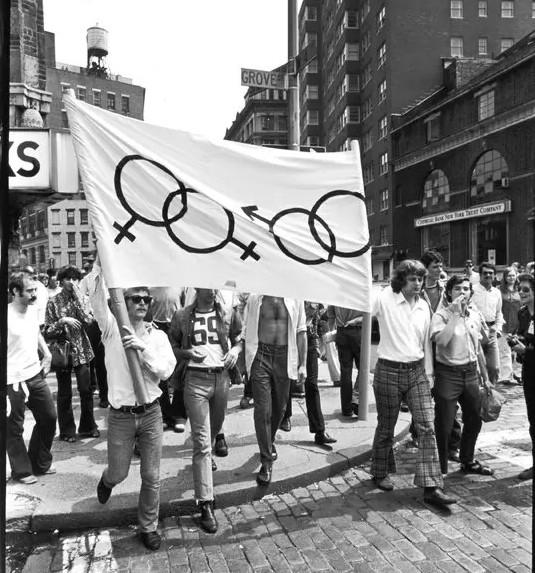
In the aftermath of Stonewall, a new generation of activists formed organizations such as the Gay Liberation Front and the Gay Activists Alliance. These groups rejected the cautious strategies of earlier homophile organizations. Instead, they embraced a politics of liberation that emphasized pride, visibility, and systemic change to demand the rights afforded to them. Drawing inspiration from contemporary, radical movements of the era, they framed the struggle for gay rights as part of a broader critique of social and political hierarchies. Their tactics included protests, “zaps” (direct confrontations with public officials), and the creation of alternative cultural spaces that celebrated queer identity.
This shift in strategy also transformed the cultural landscape. The emergence of openly gay publications, community centers, and public events challenged longstanding stereotypes and expanded the visibility of LGBTQ individuals. The first Christopher Street Liberation Day march in 1970, commemorating the anniversary of Stonewall, exemplified this particular shift. What began as a protest evolved into an annual tradition, now widely recognized as Pride, symbolizing both resistance and community. Through these public expressions, the movement redefined homosexuality from a stigmatized condition of the psyche into a source of collective identity and political solidarity.
At the same time, internal tensions shaped the trajectory of the movement. Questions of gender, race, and class exposed divisions between activists. Lesbian women, for example, often found themselves marginalized within male-dominated organizations and sought to articulate their own political agendas, sometimes aligning with feminist groups. Similarly, activists of color highlighted the intersection of racial and sexual oppression, challenging the movement to broaden its scope beyond the concerns of white, middle-class participants. Likewise, the trans sub-community within the LGBTQ faced similar issues. These debates reflected a broader struggle over the meaning and direction of liberation, one that would continue to evolve in subsequent decades.
Nevertheless, the developments of the 1960s marked a fundamental transformation in the Gay Rights Movement. The shift from cautious advocacy to open resistance reshaped the movement’s goals and its methods. By asserting visibility and demanding recognition, activists forced American society to confront its assumptions about sexuality and citizenship. The movement was no longer confined to the margins. It had entered the national consciousness as a legitimate political force.
Long-Term Consequences for LGBTQ Rights
The legacy of 1960s gay rights activism is evident in the profound changes that followed. In the decades after Stonewall, activists successfully challenged the classification of homosexuality as a mental illness, culminating in its removal from the American Psychiatric Association’s Diagnostic and Statistical Manual in 1973. Legal reforms gradually decriminalized same-sex relationships, while anti-discrimination laws expanded protections in employment, housing, and public accommodations. Though progress was uneven and often contested, the foundations laid in the 1960s by the courageous activists made these achievements possible.
Equally important was the transformation of public consciousness. The movement’s emphasis on visibility and pride reformed cultural attitudes, fostering greater acceptance and understanding over time. Media representation, academic scholarship, and public discourse increasingly reflected the presence and contributions of LGBTQ individuals. While prejudice and inequality persisted (even today, decades later), the notion that homosexuality should remain hidden or suppressed lost much of its legitimacy.
The Enduring Significance of Gay Liberation
In my final analysis, the Gay Rights Movement of the 1960s represents a critical turning point in American social and political history. It transformed a marginalized and largely invisible population into an organized and assertive community capable of demanding real change for the better. Like the women’s movement and the broader struggle for civil rights, it demonstrated the power of forceful and collective action to challenge entrenched systems of inequality.
The movement’s legacy lies not only in its tangible achievements but also in its redefinition of identity and citizenship. By insisting on the right to exist openly and authentically, activists expanded the boundaries of American democracy. The tension between assimilation and liberation, between working within the system and challenging it from without, continues to shape LGBTQ politics today.
While the movement faced internal divisions and external resistance, its impact remains undeniable. It altered the trajectory of American society, making issues of sexuality a matter of public concern and political debate. In doing so, it affirmed a broader principle, that being that justice requires not only legal reform, but the courage to confront silence, stigma, and exclusion at their roots.
Bibliography
D’Emilio, John. Sexual Politics, Sexual Communities. University of Chicago Press, 1983.
Carter, David. Stonewall: The Riots That Sparked the Gay Revolution. St. Martin’s Press, 2004.
Faderman, Lillian. Odd Girls and Twilight Lovers. Columbia University Press, 1991.
Duberman, Martin. Stonewall. Plume, 1994.
Armstrong, Elizabeth A., and Suzanna M. Crage. “Movements and Memory: The Making of the Stonewall Myth.” American Sociological Review, 2006.
Hall, Simon. Rethinking the American Anti-War Movement. Routledge, 2012.


Leave a Reply